
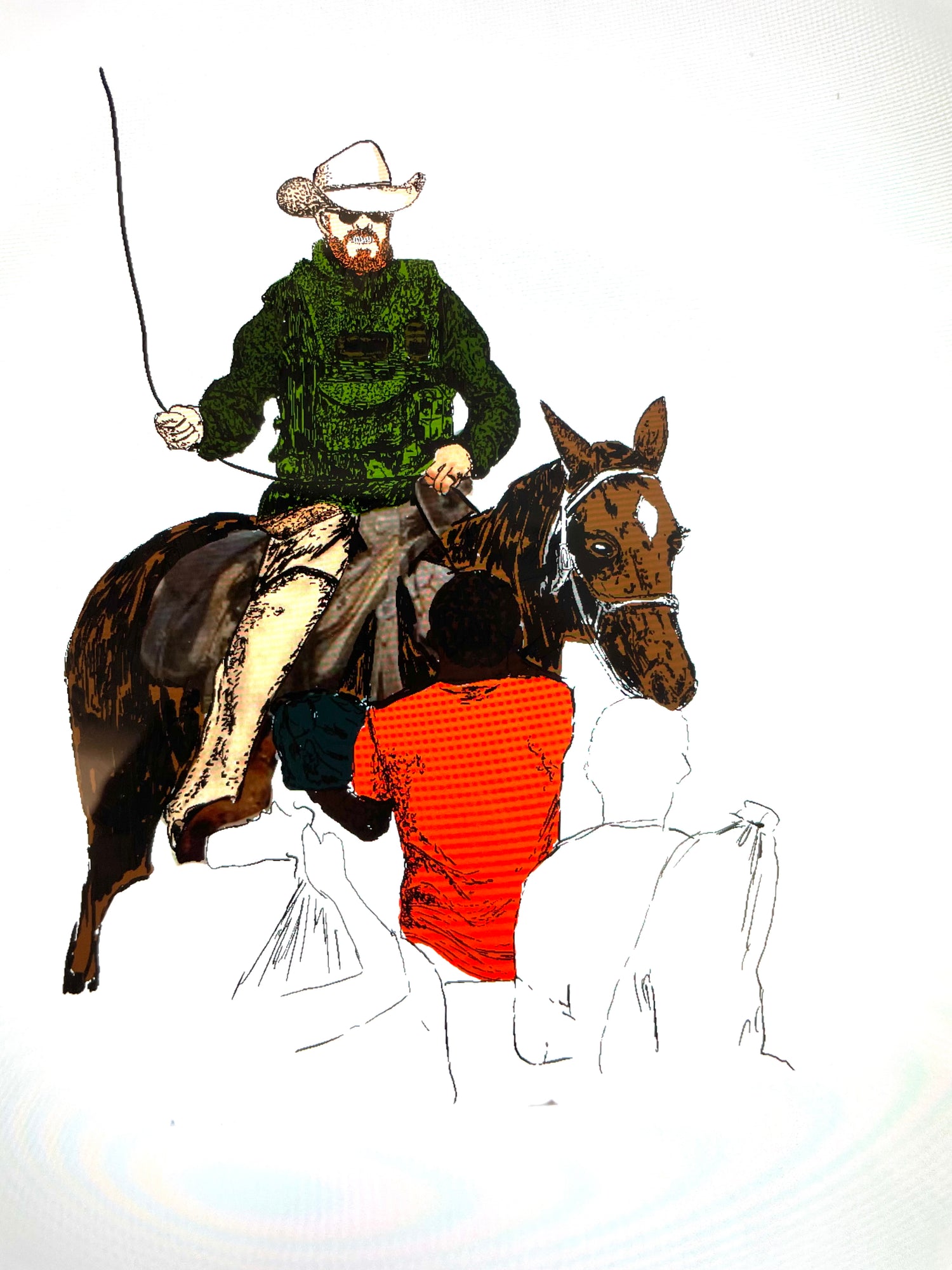
BADLANDS, 2022
This series was born in outrage. Sparked by the brutal images of border patrol officers on horseback corralling Haitian immigrants at the U.S.–Mexico border, the work confronts the unrelenting machinery of exclusion—the violent theater of borders, and the suffering it manufactures in real time. These are not just images of atrocity. They are elegies. They are warnings.
Each piece in the series serves as both witness and indictment, drawing attention to the absurdity of geography as a justification for cruelty. Borders are treated here not as neutral markers of land, but as arbitrary inventions—lines drawn in the sand that calcify into policy, punishment, and spectacle. These lines do not protect. They sort. They separate. They decide who gets to suffer.
The series dares to ask: what happens when an entire system is designed to recognize papers before people? It presents the border not as a place, but as a myth of control—a ritual maintained through force, fear, and repetition. These works strip the myth bare, exposing it for what it is: a colonial relic in new clothes, deployed against those already displaced by the violent histories of empire, extraction, and abandonment.
In this context, the figures in the work—sometimes rendered with deliberate distortion or fragmentation—are not only victims but survivors. Their humanity radiates through the abstraction, insisting on recognition in a world that would rather look away. In a moment obsessed with division, the series offers a visual protest against amnesia. It names what so many institutions would prefer to forget: that the dehumanization of Black and brown migrants is not a glitch in the system—it is the system functioning exactly as designed.
There is rage in this work, yes—but also clarity. The clarity that borders are not natural, and never have been. That love does not stop at checkpoints. That every deportation is a decision, and every act of erasure has a witness.
In the end, the series asks us to reckon with more than policy. It asks us to look at ourselves. To ask what kind of world we live in when the most vulnerable are treated as threats. It refuses the numb comfort of “that’s just how it is,” and offers, instead, a vision grounded in radical accountability. It reminds us that war is not only fought with bombs—but with paperwork, patrols, and silence.
And if the act of creation is resistance, then this series resists with force. It resists with mourning. It resists with love.