
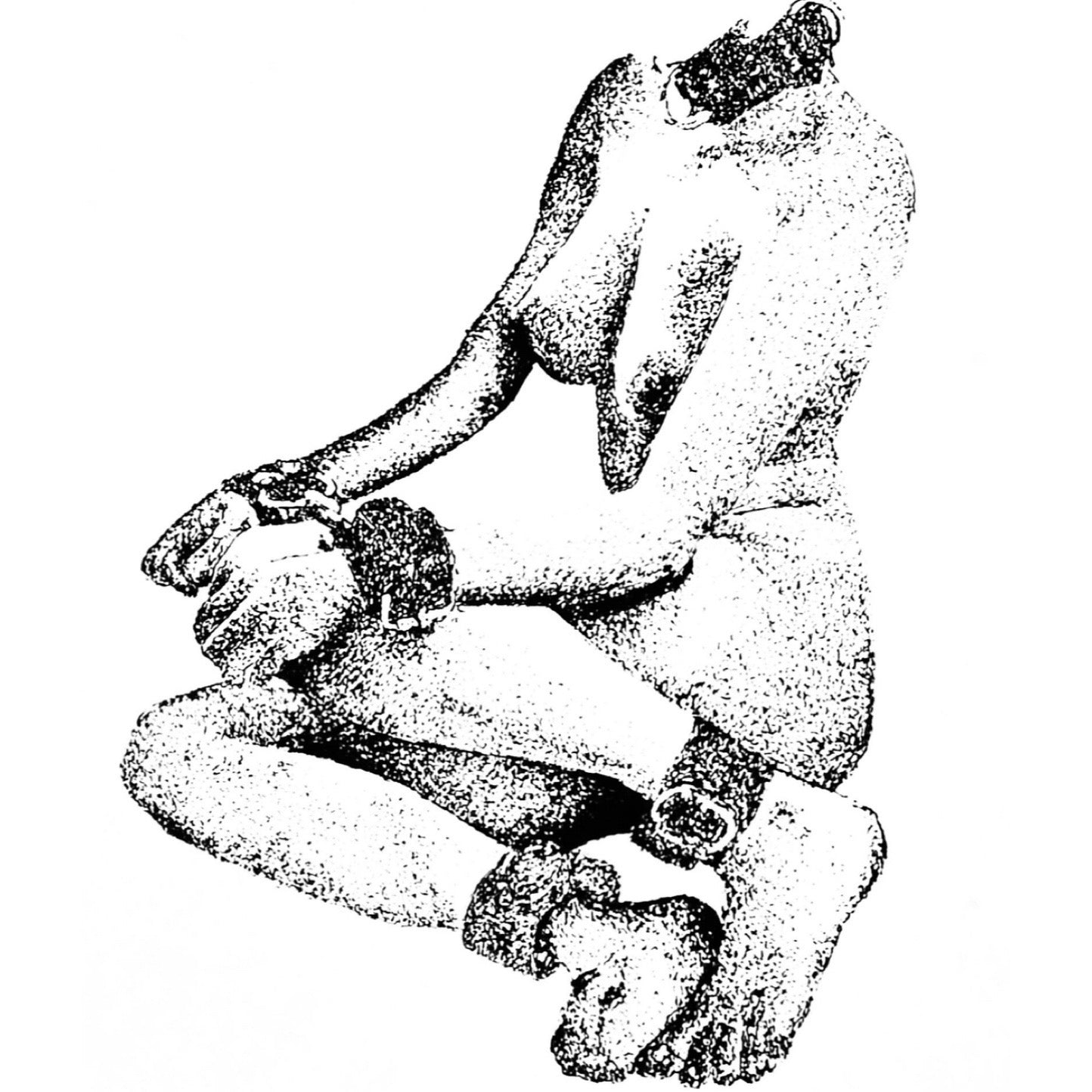
FILTH & ILLUSION, 2016
This stippling series explores the persistent constraints placed upon women’s bodies within the shifting but unyielding architecture of public life, media representation, and consumer advertising. These constraints are not always grotesque or violent in the traditional sense. More often, they arrive dressed in civility: in curated images, refined gestures, aspirational messaging, and the subtle eroticism of compliance. They are sold as aesthetics, as wellness, as empowerment—yet what they often reinforce is a form of gendered bondage that is both visible and invisible, material and symbolic.
Rendered through the meticulous medium of stippling, this series mirrors the slow, almost imperceptible accumulation of social pressure. Each dot, placed by hand, echoes the small acts of surveillance, expectation, and reduction that construct womanhood not as a self-defined identity, but as a curated spectacle. The process of pointillism, repetitive and painstaking, parallels the psychological and emotional labor involved in performing femininity under patriarchal scrutiny. To stipple is to participate in a form of ritualized control: a choreography of restraint. The images that emerge are never clean or instant; they emerge through patience and pressure—much like the social formation of gender itself.
At the heart of this work is Simone de Beauvoir’s seminal insight in The Second Sex: “One is not born, but rather becomes, a woman.” In this formulation, woman is not an essence but a position—one constructed through time, through expectation, and most powerfully, through the gaze of the Other. For de Beauvoir, the male subject situates himself as the norm, the universal point of reference, while woman is defined only in opposition—Othered, demoted, essentialized. This structural asymmetry has not only shaped the philosophical foundations of Western subjectivity but has bled into its visual and material culture.
The stippled figures in this series reflect this condition of being looked at, but never fully seen. They are partially abstracted, fragmented, and frozen in the act of being consumed. The act of visibility is presented not as liberation but as discipline. To be seen is not to be known; it is to be framed. These works do not attempt to rescue or reclaim the female body from objectification. Instead, they linger inside that condition, interrogating it, refusing to turn away.
bell hooks deepens this inquiry in her writings on the “oppositional gaze” and the power dynamics of looking. In Black Looks: Race and Representation, hooks challenges not only the patriarchal gaze but also its racialized dimensions. She writes: “The gaze has always been political in my life.” In this series, the gaze is not passive or aesthetic—it is a weapon. It is a means of containment, of capture. Through the repetition of marks, the series reenacts the surveillance embedded in femininity: how bodies are monitored, contorted, and evaluated. To be a woman under the gaze is to live in a hall of mirrors, never quite locating yourself, always being reflected back as something alien.
Yet these works are not merely an archive of oppression. They are haunted by irony, tension, and resilience. There is a kind of humor in their refusal to perform easily legible femininity. Their gestures are exaggerated or masked; their forms blur the boundary between classical beauty and grotesque parody. Some of the figures appear ornamental, others strained. Some are bound in ropes, not as symbols of erotic pleasure, but as emblems of the ties that aestheticize submission. These ropes don’t bind the body so much as they trace the lines along which the body has already been shaped by a system not of its own making.
The series also asks: what happens to desire under these conditions? If eroticism is often entangled with the act of looking, how does one reclaim a desire that has been so thoroughly structured by objectification? What is the distance between being desired and being consumed?
In this way, the work enters into conversation with both feminist theory and art history—challenging the trope of the “female nude,” not by negating it, but by recontextualizing it. These aren’t nudes in the traditional sense. They are not reclining or inviting. They are resisting through presence. The stippling process, with its obsessive rhythm, emphasizes time over form. It says: you will not see this body quickly. You must spend time. You must stay. But even then, the body may elude you. There is no clarity here, only complexity.
The material choice—ink on linen—also carries its own quiet symbolism. Linen, historically associated with domestic labor and women’s work, becomes the ground upon which these bodies assert themselves. The very fabric of the work is a palimpsest of femininity’s past. By layering slow, deliberate marks upon this surface, the series rewrites those histories—not to erase them, but to complicate them. Here, the domestic becomes political. The decorative becomes radical.
In the broader cultural moment, these images speak to the ways in which advertising and media continue to traffic in the language of empowerment while perpetuating aesthetic regimes that punish deviation. Terms like “body positivity” and “self-love” are often co-opted by industries that profit from women’s insecurity. Empowerment becomes another commodity, another script. The stippled bodies, however, refuse the smooth, airbrushed aesthetic of capitalized confidence. Their surfaces are noisy, imperfect, time-consuming. They cannot be consumed at a glance. They require discomfort.
And discomfort, as de Beauvoir and hooks both remind us, is necessary for liberation. It is in the space of friction that change becomes possible. These works do not offer solutions. They do not redeem or resolve. Instead, they present the question: what does it mean to exist in a world where visibility itself is a form of captivity?
There’s also an implicit acknowledgment of performance here—of the theatricality required just to move through public space. Femininity, in this context, is both costume and cage. The figures in these works carry traces of that tension. Some appear aware of their own spectacle. Others seem lost within it. All are shaped by it.
And still, there is something else—a pulse beneath the surface. The accumulation of dots, while methodical, is also meditative. It suggests a kind of intimacy. An intimacy with the body, with time, with form. Even as the images critique the mechanisms of objectification, they also participate in an act of devotion: of staying, of returning, of seeing slowly. In this way, the process itself becomes a feminist gesture. A refusal to rush. A refusal to flatten.
Ultimately, this series is not about rescue or reclamation. It does not seek to liberate the female body from the gaze, because it knows that such liberation cannot happen on the surface. Instead, it sits within the mess—within the contradictions, the layers, the long histories of seeing and being seen. It is a visual essay on containment and resistance. A portrait of woman not as muse, but as mirror—reflecting back the distortions of a culture that cannot quite look her in the eye.
These works are about being watched, yes—but also about watching back.