
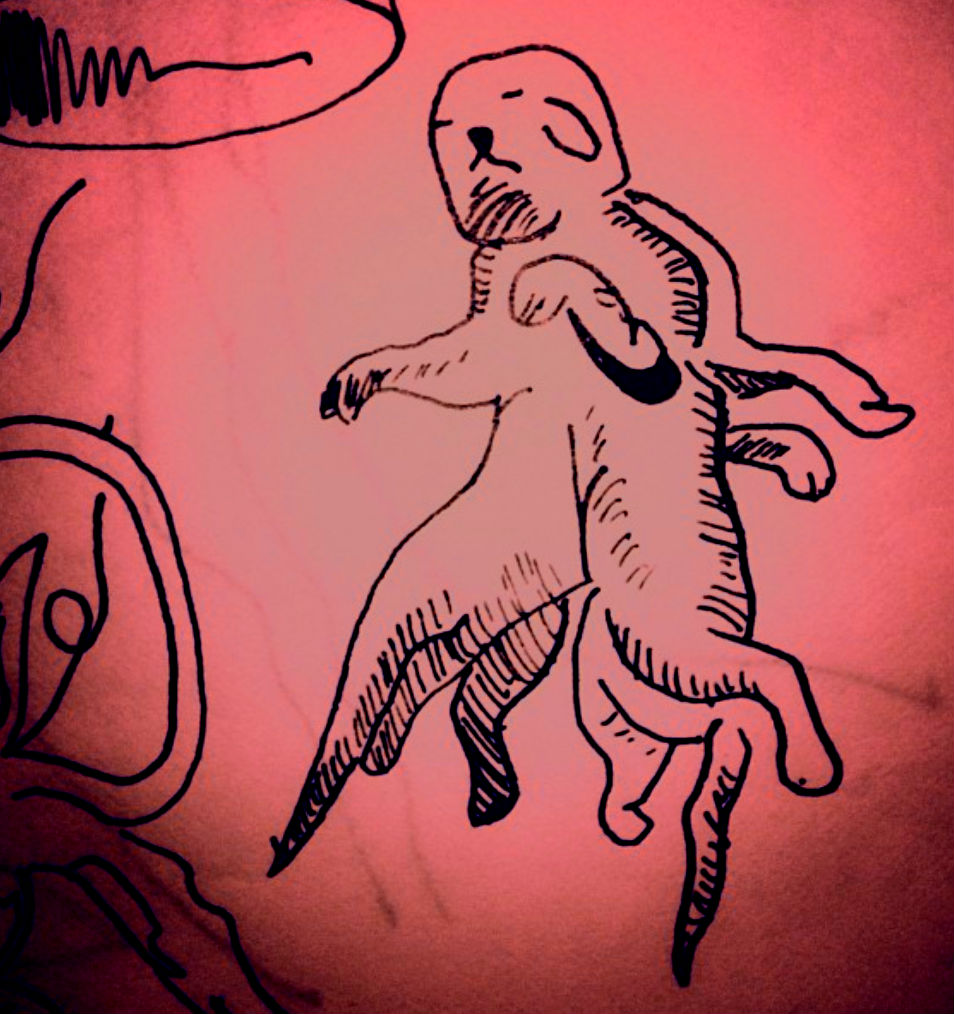
THE DOG WITH LEGS FOR DAYS
In this collage series, a familiar trope—the dog, the loyal symbol of affection and simplicity—is twisted ever so slightly into something disorienting. With six legs, the dog becomes a site of subtle absurdity, unnoticed mutation, and quietly hilarious horror. We look at it, and then we look again. We laugh. Then we wonder: Wait—was it always like that?
This delay in recognition is the first victory of the straw man.
The straw man fallacy is the act of replacing a complex, nuanced position with a distorted, simplified caricature—easy to attack, easy to accept. The six-legged dog is that caricature: familiar enough to avoid scrutiny, strange enough to be deeply wrong. Through cheerful pink hues and carefully curated collage work, the artist constructs a world where distortion becomes digestible, even charming. But take off the pink lenses, and something is off. The comfort of illusion collapses. The legs are there. The falsity is undeniable.
Jean-Paul Sartre’s concept of bad faith—our tendency to lie to ourselves in order to avoid the anguish of freedom—resonates profoundly here. In Being and Nothingness, Sartre argues that we willingly adopt roles and narratives not because they are true, but because they are easier. The pink lens, overused and cliché, symbolizes this desire for simplicity. We prefer the filtered image. We accept the six-legged dog because to challenge it would mean confronting the terror of uncertainty: What else have we misrecognized? What else have we accepted without looking closely?
The six-legged dog, then, is not a joke. It is a crisis in miniature.
The series plays with the dissonance between absurdity and truth. The more absurd the dog becomes—through collage repetition, exaggeration, or ironic slogans—the more it mirrors the cultural mechanism of substitution. We replace reality with something that looks like it, but is easier to handle. The straw man is not just a logical fallacy; it’s an ontological one. It replaces being with theater.
In this context, the question “How long has the dog had six legs?” becomes metaphysical. It isn’t about the dog. It’s about the viewer. The question reveals our complicity. It asks us when we stopped paying attention. It reminds us of Sartre’s terrifying proposition: there is no stable essence, no eternal form. Only what we choose to see—and often, we choose the false.
Through repetition, surreal humor, and pastel deception, this series explores how absurdity is not the enemy of modern thought, but its foundation. The six-legged dog is everywhere: in our politics, our branding, our inner narratives. We defend illusions we never looked at closely. We love what we do not understand. We hate what we have misrepresented.
This work does not offer a correction. It offers a confrontation.
The dog still has six legs. What changes is the eye that finally sees them.