
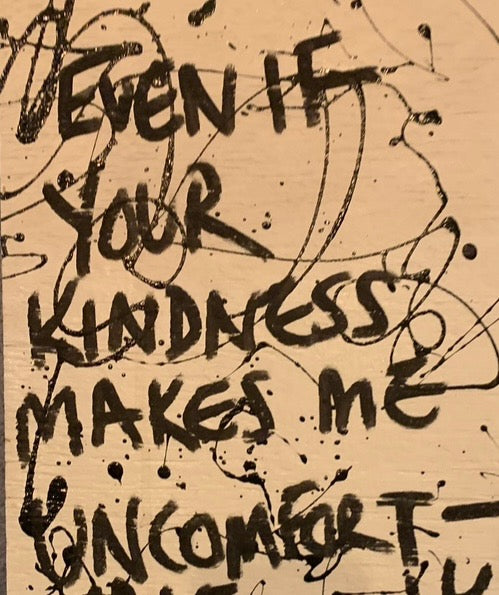
TROPIC CONFESSIONS, 2022
In Tropic Confessions, humor and absurdity take center stage, weaving together moments of real-life confessions and offbeat statements that have either been said to the artist or overheard in passing. The series revels in the unpredictable nature of human speech, transforming seemingly trivial or absurd remarks into profound reflections on how people interact, perform, and express themselves in a chaotic, often misinterpreted world.
At the heart of the series is a playful commentary on the spontaneity of the “other”—the unpredictable nature of human interaction. This is not a simple reflection of individual truths or confessions, but an exploration of how these confessions, often humorous or brash, unfold in moments of intense, unfiltered honesty. What these confessions reveal is not simply an individual’s perspective, but the deeply performative nature of self-expression. We are all, in a sense, actors on a stage, constantly engaged in the act of presenting ourselves to others—sometimes truthfully, sometimes absurdly, and often in ways we don’t fully control. The series invites the viewer to consider how these confessions, delivered in a playfully absurd tone, reflect larger themes of identity, social performance, and the complexity of human communication.
There is an undeniable activist undercurrent in Tropic Confessions, as the absurdity of the confessions mirrors the performative nature of social and political activism. Activism itself often navigates between brash, in-your-face tactics and the quieter, more nuanced work of advocacy. In this series, the absurd becomes a tool for highlighting the contradictions inherent in everyday life and the often-complex relationship between public and private selves. By taking real confessions that might seem trivial or humorous and elevating them into the realm of artistic expression, the series critiques both societal expectations and the way in which personal truths are shaped by external forces.
In a world where identity is constantly performed and redefined—especially in the digital age, where memes and social media blur the lines between self-expression and performance—the absurdity of Tropic Confessions reveals how we navigate complex social norms, how truth is often filtered through absurdity, and how spontaneous moments of communication can shed light on the deeper absurdities of contemporary existence. Through humor, the series becomes a kind of social commentary on the performative aspect of our daily lives, where we confide, confess, and express ourselves in ways that often feel out of context or, at times, completely disconnected from reality.
Drawing from activism, the series questions the very notion of truth in a postmodern world. It challenges viewers to engage with the absurd not as a form of escapism, but as a way to confront the contradictions in society. Activism itself often requires the embrace of spontaneity and the willingness to confront uncomfortable truths in unpredictable ways. Similarly, Tropic Confessions uses humor and absurdity to highlight how we process information, how we present ourselves, and how we make sense of a world where meaning is often elusive and in constant flux.
The performance of confession itself becomes a metaphor for social action. Just as activists engage with the public to reveal uncomfortable truths or challenge societal norms, Tropic Confessions exposes the chaotic, unpredictable ways in which people communicate—offering insight into how these spontaneous outbursts, while seemingly absurd, can reveal deeper insights into our shared human experience. By blending the playful with the serious, the series asks the viewer to consider how they, too, perform their truths and how the spontaneity of language and action shapes our understanding of ourselves and others.
Ultimately, Tropic Confessions is a work that balances humor and activism, absurdity and truth, inviting the viewer to reflect on the power of confession and the spontaneity of human interaction. It is a reminder that the absurd is not merely a joke but can be a tool for exploring the complexity of human experience in a world defined by its contradictions and performative acts. Through this play on play, the series asks: How do we truly express ourselves in a society that often demands that expression be filtered through lenses of expectation, irony, and contradiction?